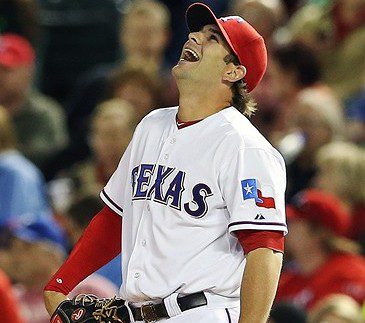
Mitch Moreland is having the last laugh after a promising start to the 2013 season.
Hey, Mitch Moreland. Your lack of production is not a laughing matter.
I might have been wrong on Mitch Moreland. To this point in the season, I might be willing to say that I was wrong about Mitch Moreland.
At least I’m willing to admit it.
I wrote about him in the past and talked about how, if given an everyday opportunity, he’d be able to show what the Rangers saw in him in the first place. He’d be able to prove people wrong about him and he’d be able to prove that he was a serviceable first baseman not only on the defensive side but also with the bat.
There have been several disagreements on this topic, and I’ve waited to say anything until I either saw a change for the better, or things began to look like they were never going to get where I wanted them to go.
For those who are reading this and wanting to drop the, “I told you so,” you can hold off on that for now because we’re only a month into the season. I don’t jump off the ship when I don’t know for sure that it’s sinking. There might be a little water coming into the boat, but I haven’t put the life jacket on yet – though I do have it in my hands, just in case.
At times, he’s looked absolutely lost at the plate — like a rookie getting his first taste of big-league pitching. Other times, he gets that smooth swing and shows off the upper-deck power he’s capable of.
Defensively, however, Moreland leaves a lot to be desired. There are plays not made that aren’t completely his fault, but, then again, he could make a better effort as well.
Maybe I should start comparing him to a certain pitcher who can never find consistency – or not.
Every time he steps to the plate, fans flood social media with comments. The majority of the time, well, 999 times out of 1,000, the assumption is Mitch Moreland isn’t going to do anything to help the team. Either it’s expecting a strikeout or, with a runner on first, grounding into a double play.
Needless to say, fans here are done with the Mitch Moreland experiment just like they were with Chris Davis when he continued to struggle with the Rangers every time he was called up from the minor leagues. Texas eventually traded Davis to the Baltimore Orioles, along with pitcher Tommy Hunter, for reliever Koji Uehara, in a deal that most saw as a “nothing for nothing” kind of deal.
In case you’re keeping score at home, Davis is currently third in the big leagues in batting average (.368), tied for second in home runs (eight), and second in RBI (24) behind another former Ranger, Mike Napoli (26).
Nothing-for-nothing deal? Does it sound like the trade that sent Adrian Gonzalez to San Diego? Not saying Mitch Moreland will turn into a Chris Davis or Adrian Gonzalez type stud, if or when he’s traded, but it does make you think a little, right?
I won’t be the one to sit here and say Mitch Moreland will be just fine, because I don’t know that for sure. The way it sits right now, it really doesn’t look like it will get any better.
One has to wonder just how long of a leash manager Ron Washington has him on. If the Michael Young situation is any indication, Wash might ride him until it’s far too late to turn back.
When July rolls around, if Moreland still hasn’t progressed, it might be in the best interest of the Texas Rangers to start looking around the trade market to upgrade the position. They can’t play Lance Berkman every day because of his knees and his age; they’ll need a guy who can improve them at the position.
I don’t mind admitting when I’m wrong. When it comes to Mitch Moreland and his ability, I’m hoping May will be a little kinder to him, and my bruised ego, then April was.
Nick Tepesch makes a radio guy look bad – I was listening to a clip of ESPN’s Randy Galloway a week ago or so, and I heard him say that right-hander Nick Tepesch didn’t belong in the starting rotation. Not only that, but he said putting him in that position wasn’t the way a potential championship team acts. Through four starts, one of them cut short by an injury, Tepesch is 2-1 with a 2.53 ERA and a .244 BAA. I know it’s early, but Nick has held his own just fine. Maybe he does deserve it after all.
Rangers dominating bullpen – Robbie Ross, Joe Ortiz, Tanner Scheppers and Joe Nathan have been nothing short of dominant out of the Rangers bullpen. The four have combined to give up a grand total of four earned runs in 42 total innings pitched (.095 ERA).
The Evolution of PayPal Betting According to Betzoid Australia
The landscape of online betting has undergone dramatic transformation since the early 2000s, with payment processing serving as a critical catalyst for industry growth. PayPal’s relationship with gambling platforms has experienced numerous shifts, regulatory challenges, and technological adaptations that have fundamentally shaped how bettors engage with digital wagering services. According to Betzoid Australia’s comprehensive analysis, these changes reflect broader trends in financial technology, consumer behavior, and regulatory frameworks across different jurisdictions.
Early Challenges and Regulatory Restrictions
PayPal’s initial foray into the online gambling sector began in the late 1990s when digital payment solutions were still in their infancy. The company initially processed transactions for various gambling websites, recognizing the substantial revenue potential in this rapidly expanding market. However, this relationship became complicated following the passage of the Unlawful Internet Gambling Enforcement Act (UIGEA) in 2006 in the United States.
The UIGEA created significant compliance challenges for payment processors, leading PayPal to implement a blanket restriction on gambling-related transactions. This decision affected not only US-based operations but also had ripple effects across international markets. Betzoid Australia’s research indicates that this period marked a crucial turning point, forcing both operators and payment providers to develop alternative solutions and navigate increasingly complex regulatory landscapes.
The restriction period lasted nearly a decade, during which time other payment methods gained prominence in the online betting sector. E-wallets like Skrill and Neteller filled the void left by PayPal’s absence, while traditional banking methods and emerging cryptocurrency solutions began establishing their presence in the market.
The Gradual Return and Market Adaptation
PayPal’s re-entry into the gambling sector began cautiously around 2016, initially focusing on jurisdictions with clear regulatory frameworks and established licensing systems. The company adopted a selective approach, partnering only with operators holding valid licenses in regulated markets such as the United Kingdom, Malta, and select European Union member states.
This strategic shift coincided with PayPal’s broader business evolution toward becoming a comprehensive financial services platform. The company recognized that excluding the legitimate gambling sector meant missing opportunities in a market worth billions of dollars annually. Betzoid Australia’s analysis suggests that PayPal’s return was driven by several factors: improved regulatory clarity in key markets, enhanced fraud detection capabilities, and the growing acceptance of online gambling as a mainstream entertainment activity.
The reintegration process involved developing sophisticated compliance systems to distinguish between legal and illegal gambling activities. PayPal implemented geolocation services, enhanced know-your-customer procedures, and established partnerships with regulatory bodies to ensure adherence to local laws. For bettors seeking comprehensive information about utilizing this payment method, a detailed PayPal betting guide became essential reading to understand the nuances of availability across different platforms and jurisdictions.
The COVID-19 pandemic accelerated digital adoption across all sectors, including online gambling. PayPal’s established infrastructure and consumer trust proved invaluable during this period, as traditional brick-and-mortar betting venues faced closures and restrictions. The company’s transaction volumes in the gambling sector increased significantly, reflecting both the growth of online betting and PayPal’s expanding acceptance among operators.
Technological Innovation and Future Developments
Modern PayPal betting integration represents a sophisticated blend of payment processing, security protocols, and user experience optimization. The platform has incorporated advanced features such as one-touch payments, biometric authentication, and real-time transaction monitoring to enhance both security and convenience for users engaging in online betting activities.
Betzoid Australia’s research highlights several technological developments that have shaped PayPal’s current position in the betting ecosystem. The implementation of artificial intelligence for fraud detection has significantly reduced unauthorized transactions, while machine learning algorithms help identify suspicious betting patterns that might indicate problem gambling or money laundering activities.
The rise of mobile betting has also influenced PayPal’s strategic direction. The company’s mobile application integration allows seamless transactions across various betting platforms, supporting the trend toward smartphone-based wagering. This mobile-first approach aligns with consumer preferences, particularly among younger demographics who represent a significant portion of the online betting market.
Looking forward, PayPal’s involvement in emerging technologies such as blockchain and digital currencies may further transform the betting landscape. While the company has maintained a cautious approach to cryptocurrency integration in gambling applications, ongoing developments in central bank digital currencies and stablecoin technologies could create new opportunities for innovation in payment processing for betting platforms.
The evolution of PayPal betting represents a microcosm of broader changes in digital finance and online gambling regulation. From initial enthusiasm through regulatory restrictions to selective re-engagement, this journey illustrates the complex interplay between technological capability, regulatory compliance, and market demand. As jurisdictions continue to develop comprehensive frameworks for online gambling oversight, PayPal’s role in facilitating secure, convenient betting transactions will likely expand, contributing to the continued maturation of the digital wagering ecosystem while maintaining focus on responsible gambling practices and consumer protection.